Last Updated on July 5, 2026 by Mandy Tyler, M.Ed., RD, CSSD, LD
Warning Signs of Eating Disorders in Athletes
It is important for parents, coaches, and athletic trainers to be aware of key warning signs of eating disorders in athletes.
Early identification and treatment for disordered eating behaviors are key for supporting the health and well-being of the athlete.
Eating Disorders in Athletes
Eating disorders and disordered eating behaviors are a health and performance concern within the athletic environment.
Although it is difficult to determine the exact prevalence of eating disorders, research has shown disordered eating behaviors are more common in athletes than non-athletes (1). It is estimated that 6-45% of female athletes and 0-19% of male athletes are impacted by eating disorders or disordered eating (2).
Which Athletes are at Risk for Eating Disorders?
Eating disorders tend to occur more frequently in female athletes. However, it is important to note that eating disorders also occur in male athletes.
In addition, athletes participating in aesthetic or weight sensitive sports, such as gymnastics, figure skating, long distance running, and wrestling, tend to be at higher risk for the development of eating disorders (3).
It has been said that eating disorders can impact “any athlete, in any sport, at any time (4).” Thus, it is important not to assume that certain groups of athletes are not at risk and overlook potential warning signs.
Given the prevalence of eating disorders amongst athletes, it is imperative for individuals within the sporting environment to be aware of key warning signs of disordered eating behaviors.
Key Warning Signs of Eating Disorders in Athletes
Although each athlete and situation is unique, common warning signs of eating disorders are shared below. Please note the list below is not exclusive.
An athlete with an eating disorder may not display all of the warning signs discussed in this blog. In addition, athletes with different types of eating disorders (i.e. anorexia, bulimia, binge eating) may exhibit different warning signs (5).
Warning Signs of Eating Disorders: Restricting Food Intake
An extreme restriction of food and calorie intake is a common eating disorder warning sign to be aware of. Restriction of food intake is frequently seen in athletes with the eating disorder anorexia as well as orthorexia.
Signs you may observe that indicate an athlete is restricting food intake include (4, 6, 7):
- Excessive counting of calories
- Weighing or measuring food
- Elimination of specific foods or entire food groups from the diet
- Rigidly following specific self-imposed food rules (i.e., no added sugars, no dairy)
- Fixation on food and preparation methods (ingredients, cooking oils)
- Ritualistic eating behaviors (i.e., cutting food in small bites, eating very slowly)
Pro Tip: Although orthorexia is not currently classified as a diagnosable eating disorder. It is a form of disordered eating behavior seen in athletes. Learn more about orthorexia in my blog: 5 Warning Signs of Orthorexia.

Warning Signs of Eating Disorders: Body Image Concerns
A preoccupation with body weight, shape, or appearance is another common warning sign of eating disorders in athletes.
Signs that may signal an athlete is struggling with body image concerns include (4, 6, 8):
- Athletes expressing feeling “fat” or disliking their body shape or figure
- Fixation with weight on the scale / frequently weighing
- Wearing baggy clothes or dressing in layers
- Rapid or extreme weight loss
- Intense fear of gaining weight
- Frequently dieting to lose weight
Warning Signs of Eating Disorders: Feelings of Guilt
Athletes with eating disorders may also express feelings of guilt or anxiety related to eating behaviors. This may include (8):
- Feelings of guilt for eating foods deemed unhealthy
- Feelings of anxiety for eating what the athlete deems is too much food (anorexia)
- Feeling guilty for engaging in purging behaviors
- Feeling ashamed for binge eating a large quantity of food
In addition, the athlete may express fear that eating the unhealthy food will impact their health and/or sports performance.
If the athlete eats something viewed as unhealthy, the individual may compensate by creating more strict food rules (9). This can in turn lead to further foods being eliminated from the diet.
Warning Signs of Eating Disorders: Avoidance of Team Events Involving Food
In the sporting environment, eating meals and snacks together as a team is common. For athletes with eating disorders, team events involving food may provoke a great amount of stress and anxiety.
The athlete may ask numerous questions about what food will be served at the event and how it will be prepared. When possible, the athlete may start to avoid team events and other social gatherings that involve food (4).
When attendance at team meals is required, the athlete may bring their own food instead of eating what is provided for the team.
Warning Signs of Eating Disorders: Evidence of Bingeing or Purging Behaviors
Evidence of bingeing or purging behaviors are additional key warning signs of disordered eating to be aware of. Athletes with binge eating disorder or bulimia nervosa (bingeing and purging behaviors) may display the warning signs shared below (4, 8, 10):
- Eating a large amount of food in a short period of time
- Eating until uncomfortably full
- Hoarding food, secretive eating
- Evidence of bingeing behavior (i.e., hidden food wrappers, purchasing large amount of food)
- Going to the bathroom after meals
- Signs of self-induced vomiting
- Taking laxatives or diuretics
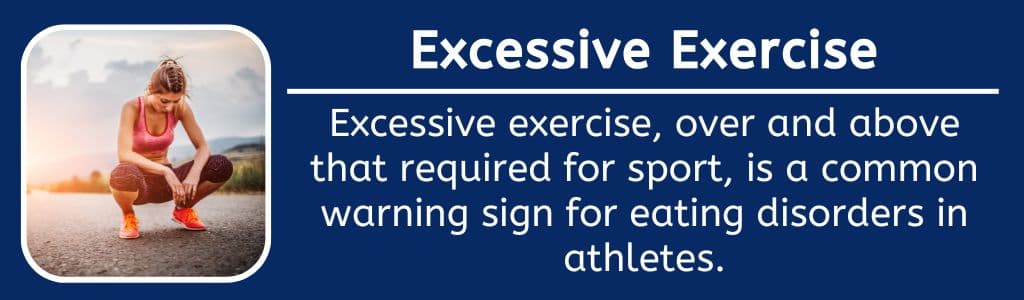
Warning Signs of Eating Disorders: Excessive Exercise
Excessive exercise, over and above that which is required for the sport, is a warning sign for eating disorders frequently seen in the athletic environment (11). Research indicates excessive exercise is problematic in both individual as well as team sports (12).
Warning signs of excessive exercise may include (4, 13):
- Exercising when injured or sick
- Refusal to take a rest day
- Exercising when the weather is bad (i.e. running in the rain or freezing cold)
- Ritualistic exercise above what is recommended by coach or training staff (i.e., additional laps in the pool, certain number of sit-ups)
- Secretive exercise
- Using exercise as permission to eat or to “burn off” calories
- Need to exercise interferes with social activities and/or relationships
- Feelings of guilt or stress when unable to exercise
Warning Signs of Eating Disorders: Irregular Menstrual Cycle in Female Athletes
Female athletes consuming inadequate calories to support their health and performance may experience irregular (or stopped) menstrual cycles.
When athletes expend more calories than they consume in the diet, inadequate energy is available to support the health needs of the body. Underfueling and low energy availability causes a disruption in normal hormone levels (estrogen and progesterone), leading to irregular periods (14).
Amenorrhea in Female Athletes
It is estimated that up to 66% of female athletes experience amenorrhea (missing 3 consecutive periods).The primary cause of the missed menstrual cycles is energy deficiency, thus correcting the energy imbalance is important (4).
Unfortunately, I find it is common for female athletes to view not having a period during their competitive season as normal. This is not the case, elite athletes (competing at high levels) should still have normal menstrual cycles (4).
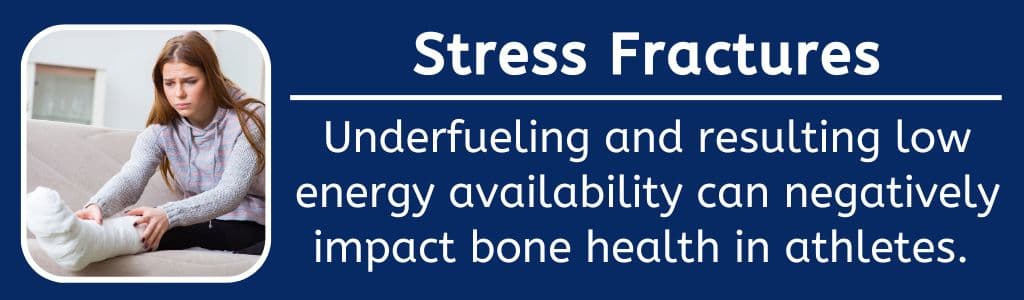
Warning Signs of Eating Disorders: Stress Fractures and Bone Injuries
Underfueling and resulting low energy availability can also negatively impact bone health. Low energy availability leads to changes in bone metabolism, including a reduction in bone formation and turn over. These changes place both male and female athletes at a higher risk of experiencing a fracture (1, 14).
In addition, female athletes who experience lack of a menstrual cycle (amenorrhea) are at further risk for bone injuries. Hormones, such as estrogen and progesterone, are crucial for bone formation. Imbalances in these hormones can lead to reduced bone mineral density and negatively impact bone health (14).
Eating Disorders in Athletes: Early Identification
It is important to recognize that disordered eating behaviors exist on a spectrum, ranging from occasional unhealthy eating and exercise behaviors to clinically diagnosed eating disorders (4).
If you suspect an athlete is showing signs of an eating disorder, or any form of disordered eating, it is important to seek help for the athlete.
Eating Disorders in Athletes: Consult with a Sports Dietitian Nutritionist
Treatment of eating disorders in athletes is best approached with the help of a multi-disciplinary team. This team typically includes the athlete’s physician, a sports psychologist or counselor, and a sports dietitian nutritionist (4).
The sports dietitian will work with the athlete to address nutrition concerns and assist with the development of an eating plan that supports the athlete’s individual needs.
Warning Signs of Eating Disorders in Athletes
You now have an overview of key warning signs for eating disorders in athletes. Consider sharing this information with your athletic teams to help increase awareness of disordered eating behaviors.
To learn more about eating disorders, visit the National Eating Disorder Association’s website. For additional information on disordered eating in athletes, make sure to check out my blog on orthorexia vs. anorexia in athletes.
Join the Nutrition By Mandy Email List & Get a Free Weekly Meal Planner Template
Click HERE to join the Nutrition By Mandy e-mail list. When you join you will receive a free weekly meal planner template to download and plan out your meals for the week.
About the Author
Mandy Tyler is a Sports Dietitian Nutritionist in the San Antonio, TX area. She is a Registered and Licensed Dietitian, a Board-Certified Specialist in Sports Dietetics, a Licensed Athletic Trainer, and is a Certified Exercise Physiologist through the American College of Sports Medicine. Mandy has experience working with athletes at the high school, collegiate, and professional levels. She believes the key to reaching one’s full potential, both in everyday life and in sports performance, relies on a healthy nutritional foundation.

If you are looking to take your performance to the next level, make sure to check out my new Sports Nutrition Game Day Guide. This downloadable guide is written to help athletes develop an individualized plan to achieve peak performance on game day.